
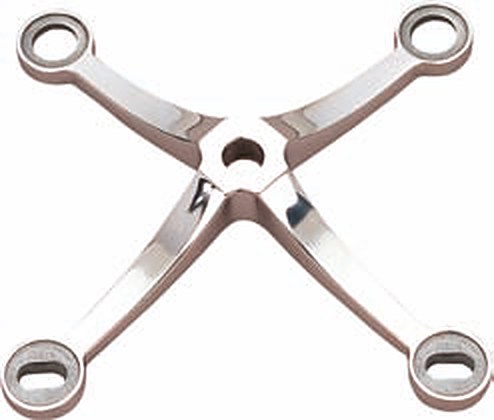
Cast Stainless Steel Spiders for Point-Supported Glass
Point-fixed glass fittings are exposed to the weather as bare, visible hardware. Our spiders are precision-cast in high-grade stainless steel for a bright appearance and dependable corrosion resistance, and are supplied in standard, heavy-duty, long-span and fin-spider ranges.
| Material | Cast stainless steel CF8 / CF8M (ASTM A743/A743M); optional duplex CD3MN (ASTM A890/A890M) |
|---|---|
| Surface finish | Mirror, satin, sandblasting, electroplating |
| Arm options | 2, 3, 4, 5 and 6-arm spiders; fin spiders |
| Load capacity | 800 N to 8,000 N per arm (Fx / Fy), by series and material |
| Glass drilling | To the bolt dimension; aluminium sleeves available for double glazing |
Spider Types for Every Glazing Load
Choose by arm configuration and recommended load. Each model is the series number plus an arm code, for example A160A4 or 220B21.
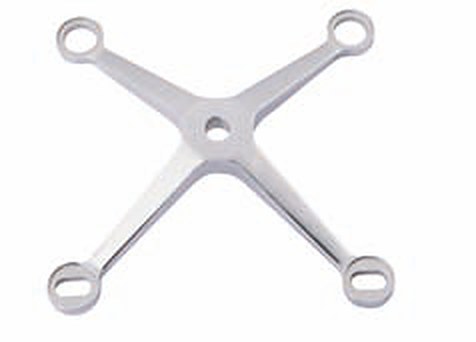
Standard Spiders
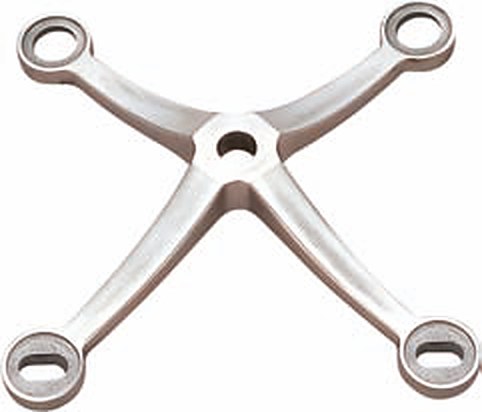
Four-arm spiders in A, B and C series, 160–300 mm, for everyday single-glazed curtain walls.
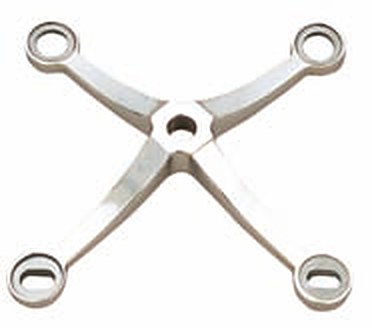
Heavy-Duty Spiders
C and D series for larger or heavier panels, rated from 4,000 N up to 6,000 N (C300A).
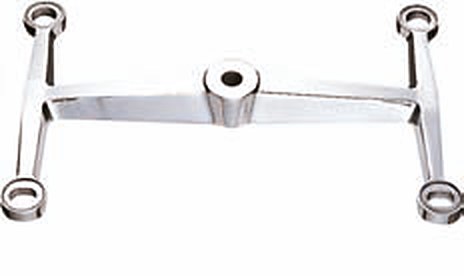
Long-Span Spiders
Two-arm H-type spiders for large glass modules, up to 6,500 N (8,000 N in CD3MN).
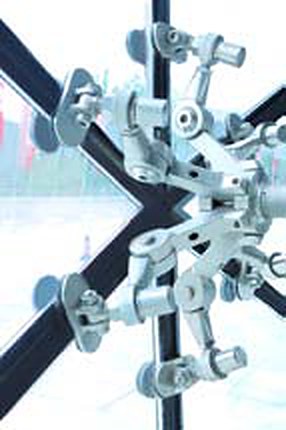
Fin & Multi-Arm Spiders
L-series fin spiders for glass-fin and steel-fin facades, plus 5 and 6-arm spiders for dome and triangulated glazing.
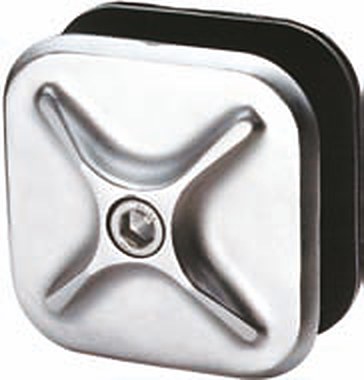
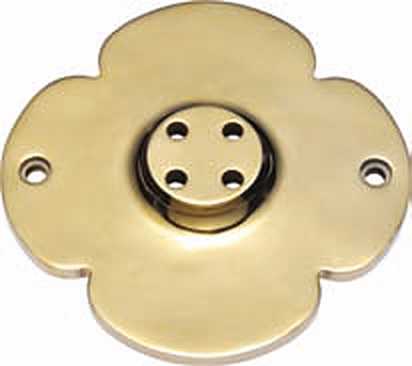
Four Finishes to Match Your Facade Design
Materials, Load Capacity & Selection
Recommended load values are for model selection. Our engineers will confirm the final selection against your glass size, wind load and fixing details.
Material Grades
- Cast stainless steel (spiders): CF8, CF8M (ASTM A743/A743M). Optional CD3MN (ASTM A890/A890M). Non-standard grades similar to CF8/CF8M on request.
- Stainless steel sheet, tube and bar: 304, 316 (ASTM A276/A276M, A666, A269/A269M). Optional 2205. Non-standard grades similar to 304/316 on request.
- Standard: point-fixed devices for construction curtain walls to GB/T 37266-2018.
Austenitic 316 / CF8M is the most widely used grade for point-fixed fittings. It is not recommended for severe environments such as swimming pools or seaside sites; select duplex 2205 / CD3MN there.
Why Choose Duplex 2205 / CD3MN
- Yield strength about twice that of common austenitic stainless steel, allowing smaller, more slender fittings.
- Higher material utilisation, which saves material.
- Excellent resistance to pitting and intergranular corrosion in harsh surroundings.
- Superior resistance to stress corrosion cracking, including in chloride and seaside environments.
- Thermal expansion close to carbon steel and reinforced concrete, so low thermal stress.
- No pre-heating or post-weld heat treatment needed; it can be welded to carbon steel.
Care & Handling
Heat-treat after casting as required, choose the grade for the environment, specify a smooth surface treatment, protect the fittings during installation, avoid fouling and water accumulation, and clean regularly.
Fx is the axial load and Fy the radial load on a single arm, in newtons. A model is the series number plus the arm code, for example A160A4 or A160A21.
Standard & Heavy-Duty Spiders
Series A, B, C, D and GZ. Where the series has no CD3MN rating, a dash is shown.
| Series | Size A (mm) | CF8 / CF8M | CD3MN | ||
|---|---|---|---|---|---|
| Fx ≤ (N) | Fy ≤ (N) | Fx ≤ (N) | Fy ≤ (N) | ||
| A160A | 160 | 1,500 | 800 | — | — |
| A200A | 200 | 2,000 | 800 | — | — |
| 200A | 200 | 2,000 | 1,000 | 2,600 | 1,300 |
| A220A | 220 | 2,000 | 1,000 | — | — |
| 220A | 220 | 2,000 | 1,200 | 2,600 | 1,600 |
| C220A | 220 | 4,000 | 2,500 | — | — |
| D220A | 220 | 5,000 | 3,500 | — | — |
| A250A | 250 | 2,000 | 1,200 | — | — |
| 250A | 250 | 2,500 | 1,500 | 3,300 | 2,000 |
| C250A | 250 | 4,000 | 2,500 | — | — |
| D250A | 250 | 5,000 | 3,500 | — | — |
| A300A | 300 | 2,500 | 1,500 | — | — |
| 300A | 300 | 3,000 | 2,000 | 3,900 | 2,600 |
| C300A | — | 6,000 | 4,000 | — | — |
| 200B | 200 | 2,000 | 1,000 | 2,600 | 1,300 |
| 220B | 220 | 2,000 | 1,200 | 2,600 | 1,600 |
| 250B | 250 | 2,500 | 1,500 | 3,300 | 2,000 |
| 300B | 300 | 3,000 | 2,000 | 3,900 | 2,600 |
| 200C | 200 | 2,000 | 1,000 | 2,600 | 1,300 |
| 250C | 250 | 2,500 | 1,500 | 3,300 | 2,000 |
| 300C | 300 | 3,000 | 2,000 | 3,900 | 2,600 |
| GZ200XFB | 200 | 2,000 | 1,000 | 2,600 | 1,300 |
| GZ220XFC | 220 | 2,000 | 1,200 | 2,600 | 1,600 |
| GZ250XFD | 250 | 2,500 | 1,500 | 3,300 | 2,000 |
Long-Span & Special Spiders
H-type and specially-configured spiders.
| Series | Size A (mm) | CF8 / CF8M | CD3MN | ||
|---|---|---|---|---|---|
| Fx ≤ (N) | Fy ≤ (N) | Fx ≤ (N) | Fy ≤ (N) | ||
| 250AA / 250AC | — | 2,500 | 1,500 | 3,300 | 2,000 |
| 250K | — | 2,500 | 1,500 | 3,300 | 2,000 |
| 3040B | — | 4,000 | 2,000 | 5,000 | 2,600 |
| 3060HA | 600 | 6,500 | 2,500 | 8,000 | 3,200 |
| 4080HA | 800 | 6,500 | 3,500 | 8,000 | 4,500 |
3060HA / 4080HA are two-arm spiders. GZ3060HTC (600 mm) is customised according to the project. C300A: when the radial load is below 3,500 N an eccentric washer meets the load requirement; above 3,500 N the slotted holes carry the load.
Fin Spiders
L-series spiders for glass-fin and steel-fin supported facades.
| Series | Size A (mm) | CF8 / CF8M | CD3MN | ||
|---|---|---|---|---|---|
| Fx ≤ (N) | Fy ≤ (N) | Fx ≤ (N) | Fy ≤ (N) | ||
| LZ200XFBJ | — | 2,000 | 1,000 | — | — |
| L200A | — | 2,000 | 1,000 | — | — |
| L210A | — | 2,000 | 1,000 | 2,600 | 1,300 |
| L220A / L250A | — | 2,500 | 1,500 | 3,300 | 2,000 |
| CL220 / CL250A | — | 4,000 | 2,500 | — | — |
| DL220A / DL250A | — | 5,000 | 3,500 | — | — |
| L220B / L250B | — | 2,500 | 1,500 | 3,300 | 2,000 |
| CL250B | — | 4,000 | 2,500 | — | — |
| L220C / L250C | — | 2,500 | 1,500 | 3,300 | 2,000 |
| L220D / L250D | — | 2,500 | 1,500 | 3,300 | 2,000 |
| L300C | — | 3,000 | 1,500 | 3,900 | 2,000 |
| L240D | — | 3,500 | 1,000 | 4,500 | 1,300 |
| L300CY / L300CN | — | 3,000 | 1,500 | 3,900 | 2,000 |
When ordering fin spiders, state whether the rubber washer or nylon sleeve is to be removed, and drill the glass to the bolt dimension.
1. Glass Panel Weight
Gk = T × B × H × ρ
- Gk weight of the glass panel (N)
- T valid glass thickness (mm)
- B width of the glass (m)
- H height of the glass (m)
- ρ gravity density of glass (default 25.6)
2. Radial Force
Fy = 1.2 Gk / ny
- Fy radial force on a single point (N)
- Gk weight of the glass panel (N)
- ny number of force-bearing points in the y direction
3. Axial Force
Fx = q × B × H / nx
- Fx axial force on a single point (N)
- q distributed design load on the glass, mainly wind load (N/m²)
- B, H width and height of the glass (m)
- nx number of force-bearing points in the x direction
For the standard four-point spider arrangement, nx = 4 and ny = 2. Select a spider whose recommended Fx and Fy are not lower than the calculated values.
How to Specify a Spider Fitting
Calculate the Loads
Work out Fx and Fy for each fixing point from glass size, thickness and wind load.
Pick Series & Arm Code
Choose a series that meets the recommended load, then add the arm code, e.g. A160A4 or 220B21.
Select Material & Finish
CF8 / CF8M or CD3MN, in mirror, satin, sandblasted or plated finish to suit the environment.
Confirm Drilling Details
Drill the glass to the bolt dimension and state if the rubber washer or nylon sleeve is to be removed.
Where Spider Fittings Are Used
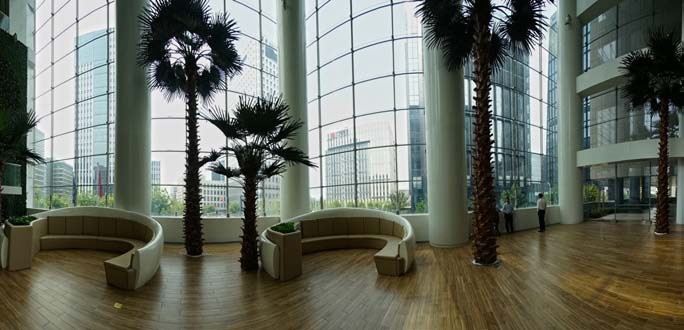
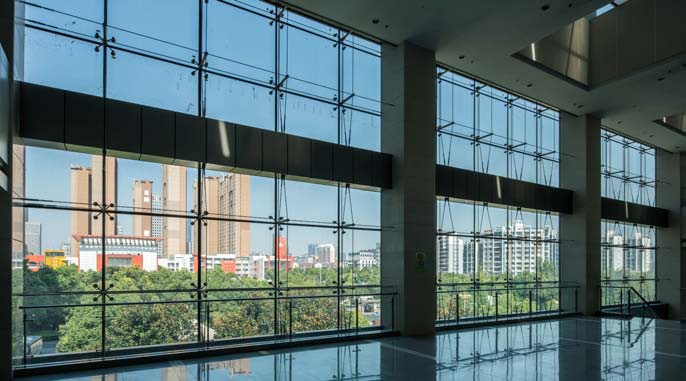
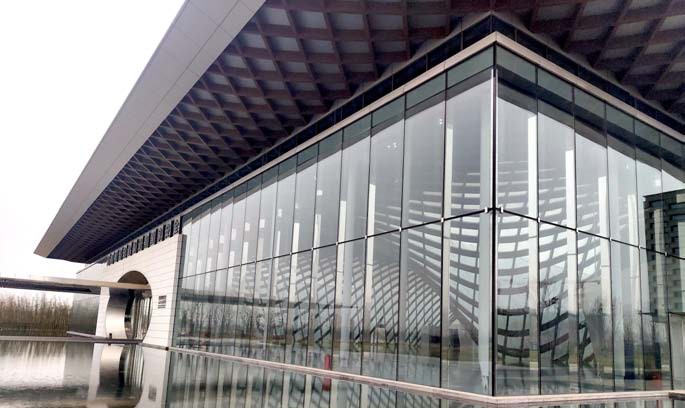
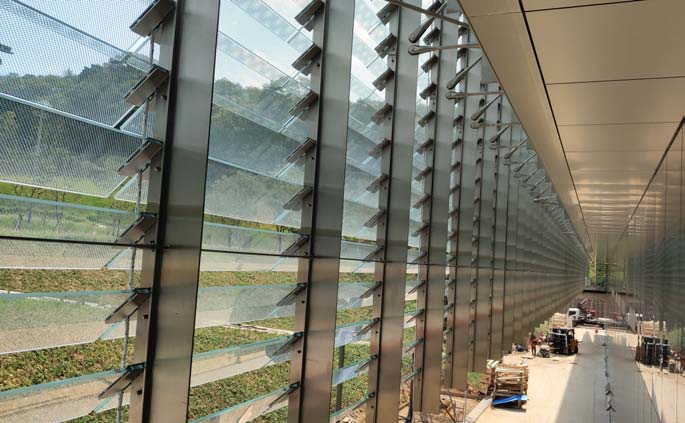
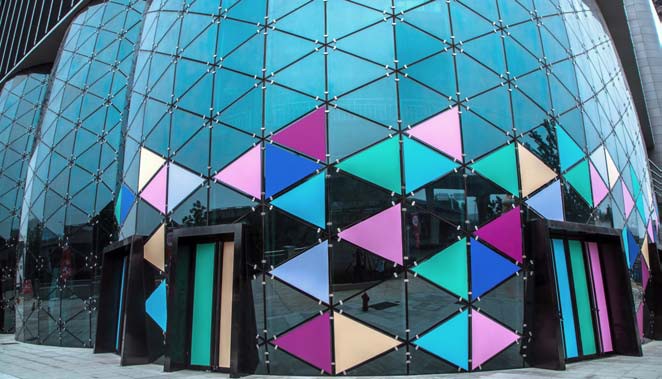
From single-layer cable-net walls to cable-truss, rod-truss and steel-fin systems, spiders carry the glass without frames or mullions.

Need Help Specifying Spider Fittings?
Send us your glass sizes, wind loads and drawings. Our specification engineers will recommend the series, material and finish, and return a written quotation.